
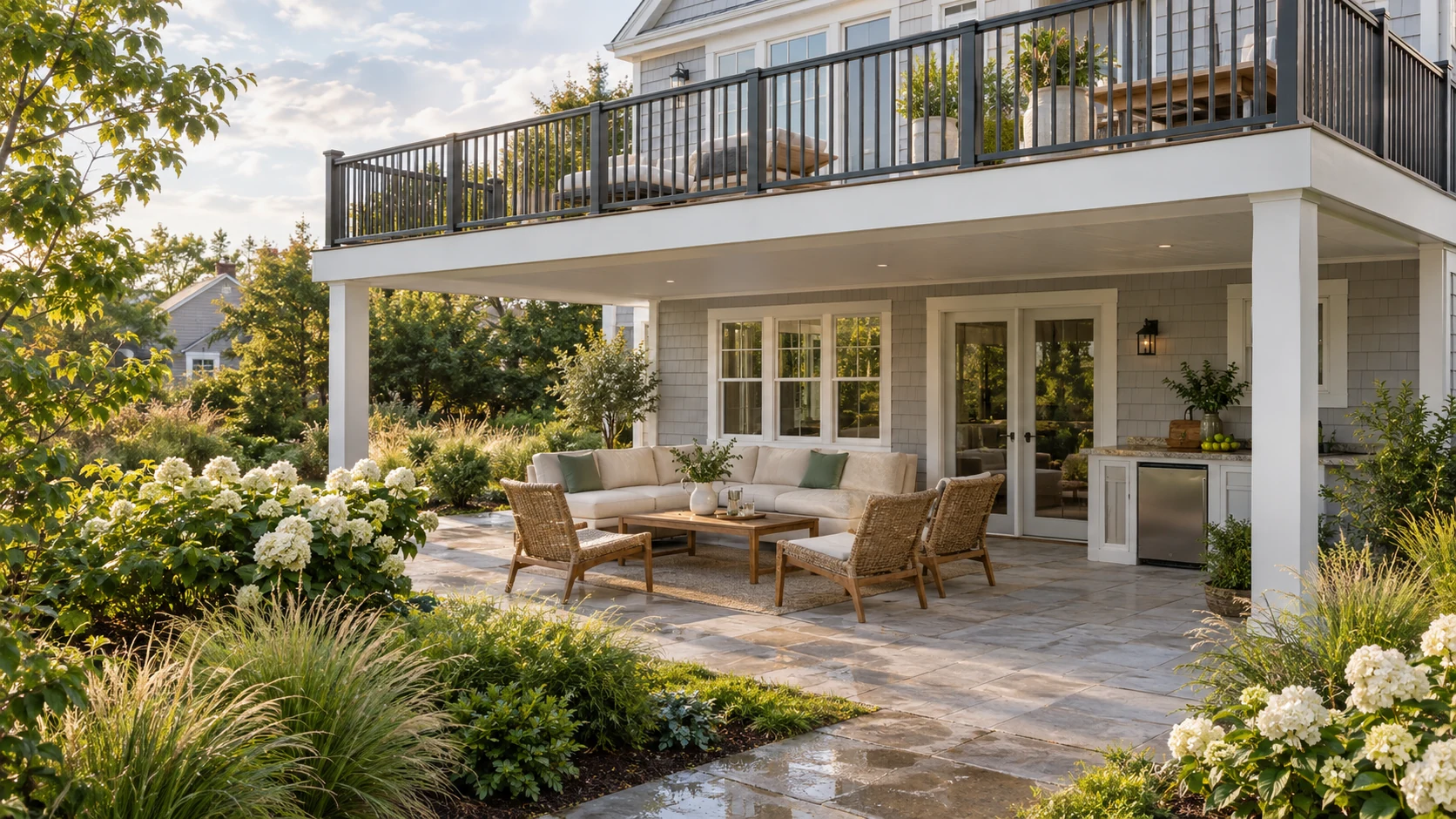
What waterproof decking actually means
A conventional deck is designed to drain through itself. Boards are spaced with a gap, rain falls between them, and whatever is underneath gets wet: the joists, the beams, the ledger, and any patio, storage, or living area below. That is fine for a deck over dirt. It is a problem the moment you want to use the space underneath, or the moment the deck sits over a garage, a porch, or a finished room.
Waterproof decking changes where the water stops. Instead of passing through the surface and being caught later, or never being caught at all, rain hits the deck and is shed off the edge the way it runs off a roof. The distinction that matters is not the brand name or the material. It is whether the waterproof layer is the surface you walk on, or something hung beneath it. Everything else in this guide follows from that one question.
It also helps to be clear about what waterproof decking is not. It is not a below-joist drainage tray, which lets the framing get wet on every storm and catches the water underneath. It is not a standard composite or PVC deck, which resists moisture as a board but still drains through its gaps. And it is not a sealer or stain applied to wood, which slows absorption but does nothing about the gaps. Those products all have a place. They are not waterproof decking.
The four ways to build a waterproof deck
Set the brand names aside and there are four architectures on the market. Each one stops water in a different place and gives you a different finished deck, above and below.
| Approach | Where water stops | Walking surface | Underside | Framing stays dry |
|---|---|---|---|---|
| Vinyl membrane | On a sheet adhered over plywood sheathing | Textured vinyl with heat-welded seams | Plywood and joists, typically enclosed | Yes, while seams and flashing hold |
| Aluminum plank | At interlocking metal planks that channel water to the edge | Coated aluminum | Flat metal ceiling, often the finished look | Yes |
| Liquid coating | On a field-applied elastomeric or polyurea film over a substrate | Textured coating | Sheathing and joists, typically enclosed | Yes, while the film is intact |
| PVC board with integrated seal | At the board gap, sealed by a gasket locked between every board | Capped cellular PVC deck board | Open, dry joists you can leave exposed or finish | Yes |
Vinyl membranes are the traditional answer for rooftop decks and balconies over living space. The membrane is the waterproof layer and the walking surface at the same time, installed over a sloped plywood substrate with seams welded on site. Performance depends heavily on the installer, the seams, and the perimeter flashing, and the finished deck looks like a membrane rather than a deck.
Aluminum plank systems interlock so each plank drains into the next and out to the edge. They are durable and genuinely waterproof, and the underside of the planks often doubles as the finished ceiling. The trade-off is the look and feel: a metal deck, with the sound and surface temperature that come with it.
Liquid coatings are painted or rolled over a substrate to form a continuous film. They are common on concrete balconies and on plywood decks in some regions. They rely on surface prep and recoating over time, and like membranes they give you a coated surface rather than a plank deck.
PVC deck boards with an integrated seal take a different route. The boards are real deck boards, the kind you would choose for looks alone, and the gap between them is closed by a gasket locked in during installation. Water never reaches the framing because the surface is the waterproof layer. Because the joists stay dry and open, the underside is a normal ceiling cavity you can finish or leave exposed. This is the category AmeriDex belongs to.
How AmeriDex works as waterproof decking
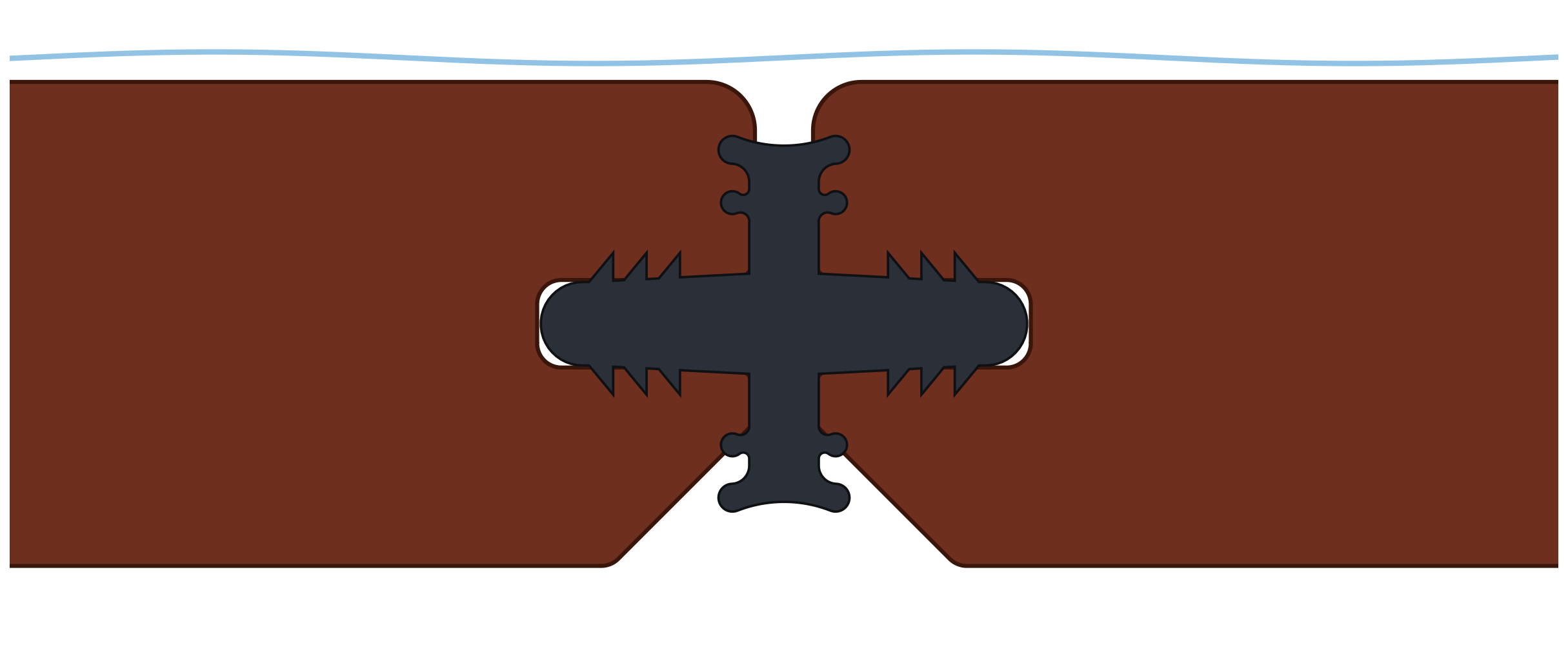
AmeriDex is a two-part system installed as one surface. The first part is a cellular PVC deck board with a proprietary ASA cap, chosen for the same reasons any premium PVC board is chosen: it does not rot, absorb water, splinter, or need staining. The second part is the Dexerdry seal, an automotive-grade TPE gasket formulated with UV and outdoor-weathering additives. As each board is fastened, the seal is compressed into the 3/16 inch gap between it and the next board. The result is a continuous, watertight deck surface on conventional 16 inch on-center joists.
Because the waterproof layer is the deck itself, there is nothing to hang underneath and no second trade to schedule. The deck builder installs the boards and the seal in one pass. Water sheds off the low edge of the deck, past a drip edge, and away from the structure. The joists, beams, and ledger never get wet, which is the part a below-joist tray can never do.
Boards ship in 12, 16, and 20 foot lengths across seven colors, with custom lengths available on request, and the integrated board and seal system is backed by a 25-year residential limited warranty and a 10-year limited commercial warranty. Made in the USA in Brick, New Jersey. For the mechanics in detail, see how the system works and the Dexerdry seal explained.
Where waterproof decking makes sense
Waterproof decking earns its place wherever something below the deck needs to stay dry. The common cases fall into four groups.
- Under-deck living space. A second-story deck over a patio is the classic case. With a waterproof surface above, the patio below becomes an outdoor kitchen, a lounge, or a covered play area that stays usable in the rain. See creating a dry space under your deck for planning ideas.
- Decks over garages and finished rooms. AmeriDex has been installed over garages and over finished, conditioned rooms as well as over patios. These assemblies need correct pitch, continuous ledger and perimeter flashing, drip edge, sealed board ends, and a builder who confirms the local code requirements for a deck over occupied space. When those details are right, the homeowner gets a real deck upstairs and a dry room downstairs.
- Elevated and coastal homes. Raised homes on the shore create an entire ground level under the deck that is either a dry, usable space or a wet, wasted one. The New Jersey Shore deck guide covers the salt air, wind-driven rain, and storm conditions that make a waterproof surface valuable there.
- Storage and equipment. Even when nobody is living under the deck, a dry space protects grills, furniture, firewood, HVAC condensers, and anything else you would rather not leave in the rain.
Why standard PVC and composite decking is not waterproof
This is the most common point of confusion, and it is worth being precise. A capped PVC or composite board does not absorb water the way wood does, so the board is moisture resistant. But a deck built from those boards drains through its gaps exactly like a wood deck. The boards are dry. The framing and the space below are soaked. Waterproof decking is about the assembly, not the board, and the assembly is only waterproof if the gaps are closed or the water is stopped by another layer.
AmeriDex starts with the board you would want anyway and closes the gap. If you are weighing board materials first, the cellular PVC versus composite comparison covers the core differences, and the under-deck drainage systems comparison walks through the alternatives that stop water underneath instead.
What a waterproof deck still needs from the builder
No waterproof decking product works on a flat, unflashed frame. The surface stops the water; the framing has to send it somewhere. AmeriDex installations follow a short list of details that any competent deck builder will recognize.
- Pitch. The framing slopes away from the house so water runs across the boards and off the outer edge.
- Overhang and drip edge. Boards overhang the outer frieze board by 1 3/8 inches, with a drip edge below, so water clears the framing instead of wicking back under.
- Ledger and perimeter flashing. Standard flashing at the house connection and around the perimeter keeps water out of the wall assembly.
- Sealed board ends. Board ends are caulked so water cannot enter the board cavity at the cut.
- Top-mount fastening, center out. Boards are fastened from the top, working from the center of the deck outward, with the seal compressed into each gap using the installation tool. Full picture-frame borders are not used because they interrupt the drainage path.
The complete sequence is in the professional installation guide, and the contractor resources page collects the documents a builder will want on site.
Can I make my existing deck waterproof?
Not by adding AmeriDex under or over boards that stay in place. The seal has to go between the boards as they are installed. That leaves two honest paths for an existing deck. If the framing is sound and can meet the pitch, overhang, flashing, and fastening requirements, a re-deck removes the old boards and installs AmeriDex on the existing joists, which is usually the most economical route to a truly waterproof deck you already own. If the boards must stay, a below-joist tray system is the category to look at, with the trade-off that the framing keeps getting wet. The existing-deck guide walks through how to tell which situation you are in.
Maintenance
Waterproof PVC decking does not need sealing, staining, or annual waterproofing treatments. Clean it with soap, water, and a soft brush. AmeriDex does not recommend pressure washing, because the concentrated stream can create micro-tears in the cap layer and disturb the seal. The cleaning guide has the full routine, and the fall maintenance checklist covers the seasonal inspection points.
What waterproof decking costs
AmeriDex is priced by the lineal foot of deck board, and the material figure covers both the board and the Dexerdry seal, because they are one product. Labor, framing, railing, trim, and permits are quoted separately by your builder or dealer. The cost guide explains what is and is not included and has a calculator that estimates materials for your own deck dimensions. For an exact number, request a written quote.
How to get started
Order free samples to see the seven board colors and feel how the Dexerdry seal locks into the board edge. Try the 3D deck designer to lay out your deck and see the dry space it creates below. Then send your dimensions through the quote form, and an authorized dealer will return a written quote covering board count, accessories, and lead time. Builders and commercial projects can reach the AmeriDex team directly through the contact page.