
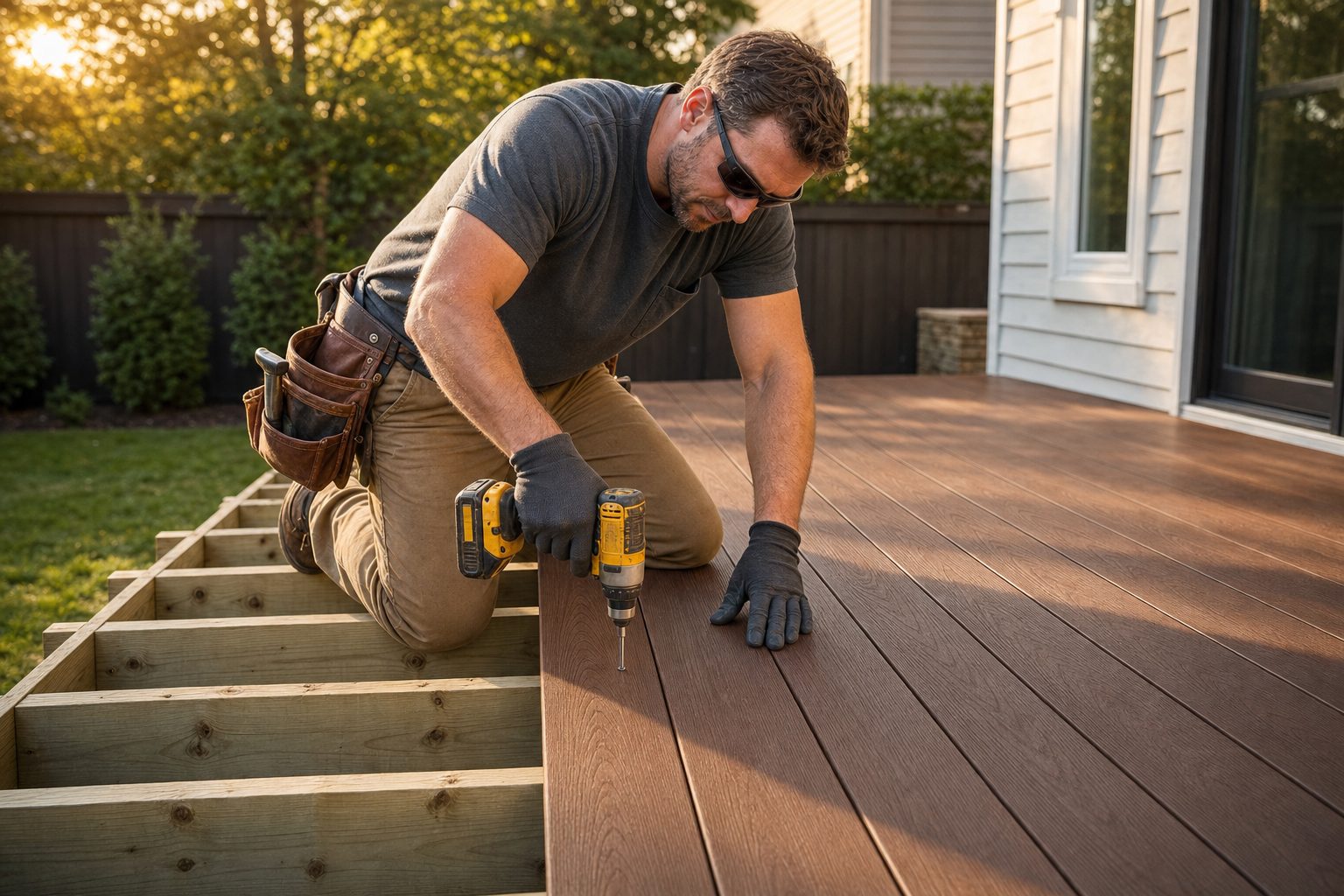
Most deck systems ask you to choose between a deck that looks good and a deck that protects the framing underneath. AmeriDex does both at once, but only if the crew installs the seal the way it is meant to go in. The good news for any builder reading this: there are no exotic tools and no surprises in the sequence. It is the same framing, fastening, and layout you already know, plus one new habit that pays off for the next 25 years.
This is a field overview, not a substitute for the official installation instructions that ship with the product. Treat it as the orientation you give a new lead carpenter before the first row goes down.
What the system actually is
The AmeriDex Dryspace System is two engineered parts working as one. The boards are cellular PVC with a proprietary ASA cap, so they will not rot, splinter, or feed mold, and they hold color in full sun. The drainage is the Dexerdry seal, an automotive-grade TPE component that locks into a routed channel on the edge of every board. Together they form an above-joist system: water sheds off the surface and the joists, beams, ledger, and fasteners stay dry. There is no below-deck tray to hang and no membrane to flash, because the water never gets past the deck surface in the first place.
Frame for drainage, not just for span
A good AmeriDex deck starts before a single board is set. The key thing to understand is that you frame the deck conventionally. Because the Dexerdry seal fills the gap between boards when it is properly compressed, you do not re-frame to angle the boards away from the house. Run the deck boards parallel to the house and let the system shed water off the overhanging edges. Set up your framing for that.
- Build in 1/8" per foot of pitch. A slight, even slope across the deck is all the runoff you need. The boards still run parallel to the house.
- Plan a 1 3/8" board overhang. Deck boards must overhang the outside of the framing by 1 3/8" on the drainage edges. That overhang is what creates the “umbrella effect” that sheds water off the sides.
- Set a frieze board at the house. A parallel deck starts with a grooved frieze board (5/4" PVC trim or deck board) routed to match your board profile and flashed to the wall, so the first run seals tight against the house.
- Keep joist tops clean and true. A crowned or twisted joist telegraphs straight into the seam. Flatten the high spots before you start.
- Hold off cutting the joist ends. Leave the joists long and cut them only when you are three to four boards from the end, so you can land a full board at the edge.
One detail that is easy to skip and important not to: cut a drip edge into the bottom of both ends of every board, roughly 7/16" to 1/2" deep and about 3/4" to 1" in from the end, before installation. It interrupts the capillary action that would otherwise wick water back into the groove and trap it in the flange.
Setting the first row
The first board sets the tone for the entire deck, so take the extra few minutes here. Tap the first piece of Dexerdry into the grooved frieze board with a rubber mallet, then set your first deck board against it, making sure the flange seats snugly into the board groove. Cut that first board to exact length before you install it, keep it dead straight along the house, and lock it down with proper compression. A straight deck depends entirely on how straight that first board goes in.
The one new habit: seat and compress the seal as you go
This is the step that makes the deck watertight, and it is the step crews new to the system tend to rush. The Dexerdry seal goes in as you build, board by board, not after the field is down. Tap each piece into the groove with a rubber mallet and a scrap beater board, then bring the next board up so its groove captures the other side of the flange. Then comes the part that matters most: the flange is a weatherproof seal, and it only works when it is properly compressed. Use an approved compression tool such as the BlueClaw or DeckWise wrench to cinch every board tight at each joist. Do not improvise this with a hammer and chisel, and run each flange in one continuous length. Tight is right.
Tight is right. Compress every board with an approved tool at each joist. If a board starts to bow, do not ease off the compression to fix it; compress tighter where needed instead.
Caulk the ends as you go. Caulk at least one inch of each end of every Dexerdry run as it is installed, to stop water wicking through the board ends. Use an approved caulk such as DAP Ultra Clear or Lexel by Sashco. Never use silicone.
Keep the groove clean and run it continuous. Inspect each board groove for dirt or damage before seating, and never splice flanges end to end with caulk or glue. Always install in continuous runs.
Fastening: top-mount, center-out, two per joist
AmeriDex uses top-mounted fasteners, because the board grooves are occupied by the Dexerdry flange rather than hidden clips. Work one board at a time: start from the center of the board and move outward, one joist at a time, driving two screws per joist and compressing tightly as you go. Cellular PVC does not require pre-drilling. The deck board and seal carry a 25-year residential and 10-year commercial warranty, and the warranty package is built around the included Starborn epoxy or stainless screws and plugs, so use them and keep your install inside warranty terms. Drive heads flush, not buried, so you do not dish the cap.
Edges and borders: respect the overhang
This is the detail that protects both the deck and your warranty, so it is worth being precise. A Dexerdry deck works like an umbrella: water has to shed freely off the 1 3/8" overhang at the edges. A full picture frame, where perimeter boards cap the ends of the field boards on solid framing, dams that water, can freeze and leak, and voids the Dexerdry warranty. If a customer wants that framed look, use the Dexerdry Picture Frame detail instead, which gives the same appearance while preserving the overhang and letting water shed. The official instructions and the “Installing Dexerdry” video walk through the exact measurements, so build from those for any picture-frame or wrap-around job.
This article is a field orientation, not a substitute for the manufacturer’s instructions. Before any AmeriDex job, read the official Dexerdry installation instructions and watch the installation videos in the order listed. Failure to install exactly as specified can void the warranty and cause the deck to leak.
Why this matters for your business
Every builder knows the real cost of a deck is not the day you finish it, it is the call three winters later. Trapped water rots joists, corrodes fasteners, and undermines the ledger, and the homeowner remembers who built it. An above-joist system keeps the structure you framed dry from day one, which means fewer warranty calls, a stronger referral pipeline, and a premium, wood-alternative deck you can stand behind. For the full mechanics behind the workflow, the above-joist deck drainage guide and the above-joist vs below-joist comparison lay it out, and why decks rot from the top down covers the failure mode you are designing out.
Because the seal is set between every board as the deck is built, AmeriDex is a new-construction system, which makes it a natural fit for builders quoting fresh decks. Want to spec it on your next job? Request free samples to put the board and seal in your hands, become a dealer to carry the line, or start a free quote to size a system for the project on your board right now.