
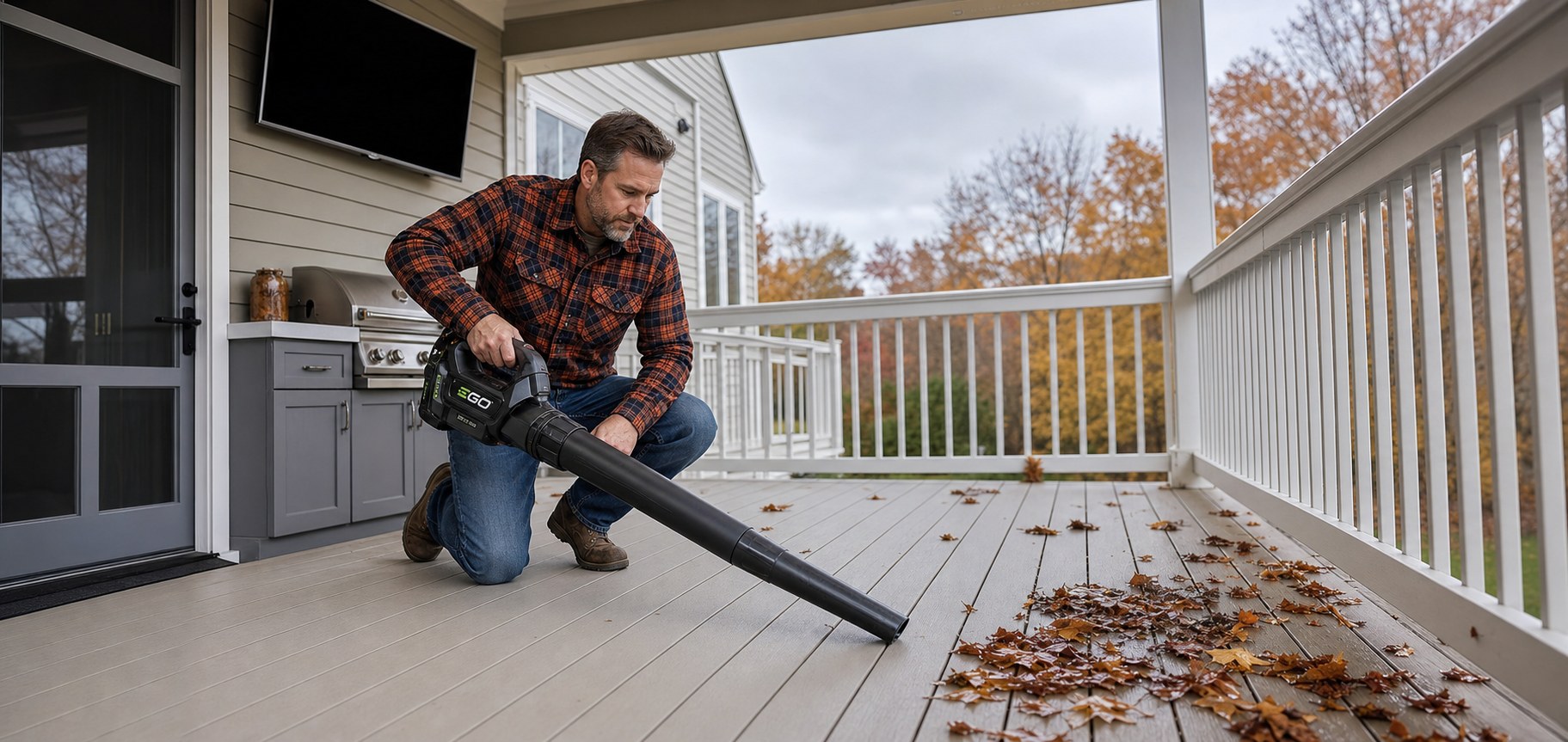

Fall is when a deck either gets set up to survive winter cleanly or gets set up for a spring surprise. Freeze-thaw cycles, wet leaves, and months of snow load are hard on framing, fasteners, and any surface that was already holding moisture going into November. None of this is complicated, and none of it takes more than an afternoon. It just has to actually happen every year.
Below is the walk-through we give homeowners who call asking what to do before the weather turns. Most of it applies to every deck, wood or PVC, above-joist or open. One item is specific to whether water is getting into your framing at all, and that is where the space underneath your boards starts to matter.
The eight-step fall checklist
- Clear leaves and debris off the surface and out of every gap. Wet leaves packed between boards or against the house-side ledger hold moisture for weeks. That sustained damp is exactly what drives rot in wood framing and corrosion on fasteners, so a leaf blower or stiff broom pass before the first hard freeze matters more than it looks like it should.
- Check the ledger board and flashing where the deck meets the house. This is the single most common source of hidden water damage on any deck. Look for gaps, curling flashing, or dark staining on the siding above the ledger, all signs water has been getting behind it.
- Inspect fasteners for rust bleed and backing out. Freeze-thaw cycles work screws and nails loose over a winter. Rust streaks running down from a fastener head mean water has been sitting on bare metal, and a loose fastener now is a tripping hazard or a board that lifts under snow load later.
- Look underneath for standing water, soft spots, and pest activity. Get a flashlight under there before the ground freezes. Standing water against a post base, soft or dark joists, and any sign of carpenter ants or termites are all easier and cheaper to deal with in October than to discover in April.
- Decide if this is a sealing year. Wood decks generally need fresh sealer or stain every one to two years, per most manufacturer guidance, and fall is the deadline for that decision because a worn top coat going into winter is a top coat that will fail by spring. This step goes away permanently on a cellular PVC surface like AmeriDex, but only once that surface is actually down, either on new construction or a re-deck where the framing qualifies. It is not something you retrofit onto the wood surface you are looking at right now.
- Clear gutters and downspouts feeding onto or near the deck. A clogged gutter above a deck turns every storm into a concentrated pour onto one section of boards and framing. Five minutes with a hose after clearing the gutter will show you exactly where the water lands.
- Check drainage and grading around support posts. Snow melt has to go somewhere. If it is pooling against a post base or footing instead of running away from the structure, that is a freeze-thaw problem building for the whole winter.
- Store furniture, grills, and planters, or raise them off the surface. Anything left flat on deck boards all winter traps moisture and snow load underneath it in one spot. Raising items on feet or storing them clears that risk entirely.
Seven of these eight items exist because water is getting where it should not be. The eighth is the one you can design out of the deck entirely.
Why item five disappears on a new or re-decked above-joist system
Sealing and re-sealing exists to compensate for a surface that absorbs water. Wood does, which is why the fall calendar includes a recurring decision about stain and sealer. Cellular PVC never absorbs water in the first place, so there is no coating to maintain and no year-by-year judgment call about whether this fall is the fall it needs redoing. That is a real, permanent change, but it belongs to whoever is standing on an AmeriDex surface, not to a wood deck that has AmeriDex boards described on a blog somewhere. The system is installed as the deck surface goes down, either on new construction or on a re-deck where the existing framing already meets pitch and overhang requirements, and it cannot be layered over boards that are already fastened in place. If you are looking at your current deck while reading this, item five still applies to you tonight. It is a fair question for your next deck, not a fix for this one.
The gutter, ledger, fastener, and drainage checks on this list are about managing where water goes on any deck. On a new or qualifying re-decked AmeriDex installation, that picture changes at the structural level rather than the surface level. Every deck board locks onto a Dexerdry seal at install, closing the gap between boards so rain sheds off the top of the deck instead of running through it onto the joists below. On that kind of installation, the framing that item four on this list asks you to inspect for rot and soft spots is framing that stays dry all winter rather than framing that gets wet in October and freezes in January. We cover the mechanism in full in why decks rot from the top down, and whether an existing deck can qualify for a re-deck in can you add a dry-space system to an existing deck.
Still do every fall, any deck
- Clear leaves off the surface and out of gaps
- Inspect ledger flashing for gaps or staining
- Check fasteners for rust bleed and back-out
- Clear gutters feeding onto the deck
- Check post-base drainage and grading
Off the list on a new or re-decked AmeriDex surface
- No fall sealing or staining decision to make
- No annual water-absorption top coat to renew
- Framing inspection checks dry wood, not wet
- No graying or splintering from freeze cycles
If this is the fall you re-deck
Some homeowners run this checklist and realize the honest answer is that the framing is past the point of another winter of patching. If that is where you land, a re-deck onto AmeriDex is worth pricing before you commit to another season of the same list. It only works if your existing framing meets pitch and overhang requirements, which we walk through in can you add a dry-space system to an existing deck. If you are planning new construction instead, planning a new deck covers the pre-construction side of the same decisions.
If you cannot remember the last time you sealed your deck and you are not sure it needs it, that uncertainty is itself the answer. Get underneath with a flashlight this weekend before the temperature drops.
Get ahead of next fall instead
Running this checklist once a year is manageable. Running it forever on a deck that keeps testing your ledger, fasteners, and framing every winter is a different commitment. Start a free quote if you want to see what a dry-space system does to this list permanently, or request free samples to feel the difference between a cellular PVC board and the wood or composite currently under your feet.