
Every decking sales conversation eventually reaches the same fork. On one side is composite decking, wood fiber blended with recycled plastic and wrapped in a protective cap. On the other is cellular PVC, a board that is 100 percent plastic with no wood fiber anywhere in it. Both are marketed as low-maintenance wood alternatives. Both look convincing under showroom lighting. But only one of them can genuinely say there is nothing inside the board for water, mold, or rot to find. This is the complete case for PVC, built from the material science, not the marketing copy, plus an honest answer to the cold-climate objection that comes up more than any other.
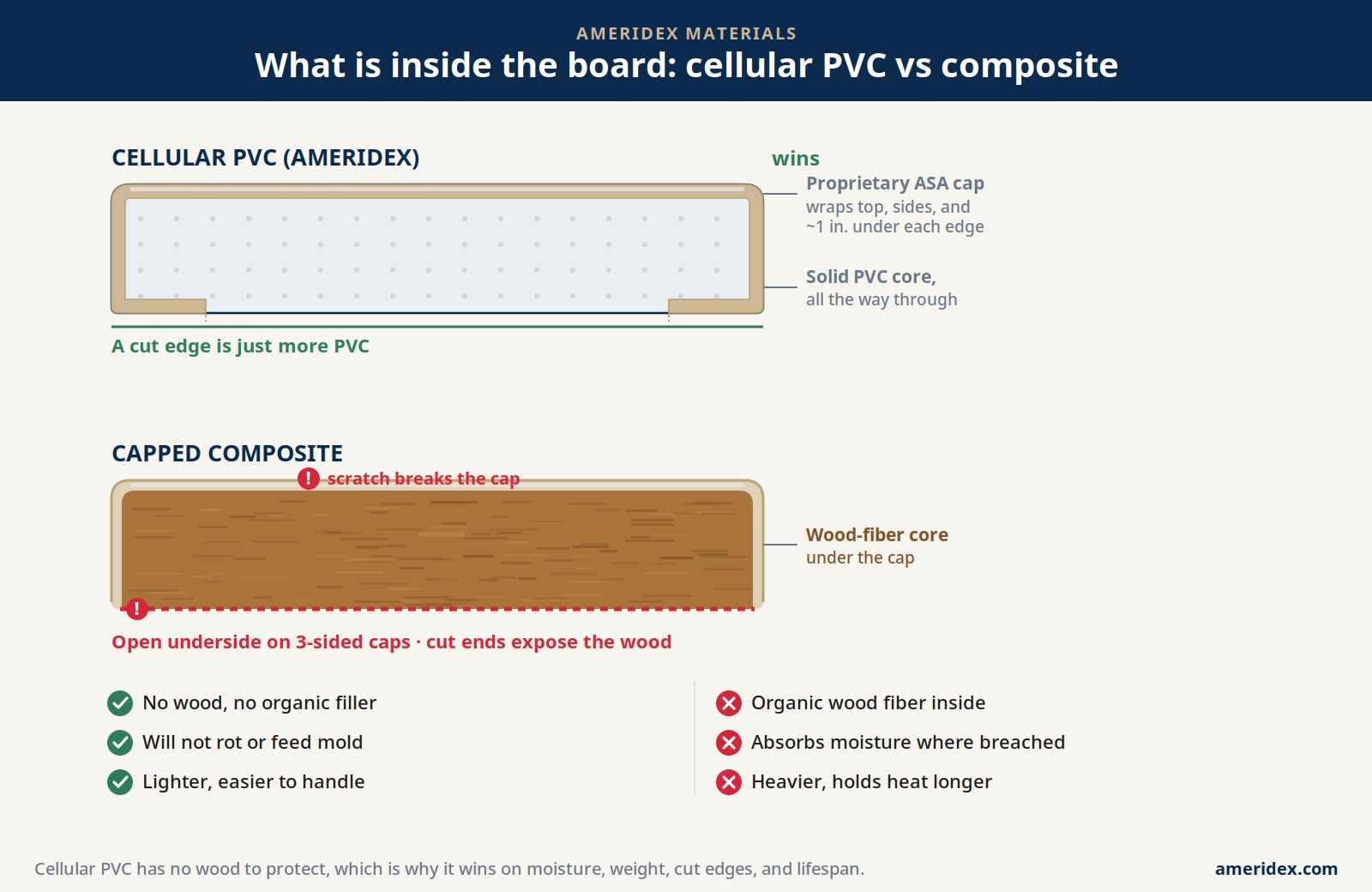

What each board actually is, underneath the finish
The core problem with composite: it still has to protect wood from water
Wood fiber absorbs water. Once it does, it swells, and that swelling drives cupping, soft spots, and the internal mold growth behind multiple class-action claims against major composite manufacturers.
The cap is the only barrier, and it is a surface treatment, not permanent protection. It gets breached in ordinary use:
- Every cut end. Cutting a board to length or notching it around a post exposes raw wood fiber at that cut, and many installers do not field-seal every cut the way the fine print recommends.
- Every scratch, drag mark, and fastener hole. Furniture, grills, dropped tools, and screws all nick the cap. Each nick is a new entry point for moisture into the wood underneath.
- Three-sided caps. Some composite lines cap only the top and two edges, leaving the bottom of the board uncapped and dependent on airflow, which is the least reliable protection on a low, shaded, or poorly ventilated deck.
Independent research on wood-polymer composites confirms it: even capped systems absorb measurable moisture over repeated wet-dry cycles, tied directly to the wood-fiber content of the core, not the cap alone.
Cellular PVC never has this problem. There is no wood fiber anywhere in the board. A cut end is just more PVC. A scratch is cosmetic. Nothing inside can swell, rot, or feed mold, because nothing inside is organic.
Composite spends its whole service life protecting the wood fiber inside it. Cellular PVC has nothing inside it left to protect.
Side by side, where it actually counts
| Property | Composite (capped wood fiber) | Cellular PVC (AmeriDex) |
|---|---|---|
| Core material | Wood flour or wood fiber blended with recycled plastic | 100% PVC, zero wood or organic filler |
| Moisture absorption | Absorbs water once the cap is breached; documented in wood-polymer composite research | Effectively zero; nothing in the core to absorb water |
| Cut ends and scratches | Expose raw wood fiber to weather | A cut is simply more PVC, no exposed organic material |
| Freeze-thaw risk | Trapped moisture can freeze and split the core from the inside | No moisture in the core, so no freeze-thaw splitting mechanism |
| Weight | Heavier per board, more load on framing and crew | Lighter per board, easier to handle and fasten on site |
| Fastening method | Can be face screwed in the same two-per-joist pattern, but generally requires predrilling a pilot hole at every screw location to avoid cracking | Face screwed with two screws per joist at 16 in. on center, anchoring the full board length, with no predrilling required |
| Typical residential warranty | Commonly 25 to 30 years | 25-year residential warranty on AmeriDex, with a material built to outlast it |
On freeze-thaw, the risk that matters is trapped moisture inside composite, a chemistry problem with no PVC equivalent, since there is no water inside a PVC board to freeze.
Why the core material matters even more in a sealed dry-deck system
A deck board is one decision. Keeping the space underneath dry is another, and it raises the stakes on the core material. The AmeriDex Dryspace System locks every cellular PVC board onto a Dexerdry seal as the deck is built, closing the gap between boards so rain sheets off the surface instead of dripping through onto the framing below.
In that system, the boards are not just a walking surface, they are the waterproofing system. That is not a job for a board that can absorb moisture at a cut, a scratch, or a breached cap. Wood-free cellular PVC is the right foundation because it is indifferent to water on every face, at every cut, in every season.
For the full mechanics of how the boards and seal work together, the waterproof decking guide compares AmeriDex to membranes, aluminum planks, and coatings, the above-joist deck drainage guide covers the system in detail, and why decks rot from the top down explains the moisture cycle that makes core material the decision that matters most.
The bottom line
Composite is a genuine upgrade over untreated wood, and a well-built composite deck can perform for decades. But it still carries wood fiber inside a cap, and caps get cut, scratched, and eventually breached, which is the failure mode that shows up in the moisture and mold complaints filed against major composite brands. Cellular PVC removes wood from the equation entirely, and it does not carry the moisture-driven failure mode that composite does. That is why PVC wins on moisture, cut-edge durability, and long-term reliability, and it is why AmeriDex builds the Dryspace System around it.
One honest note on cold-weather movement
Like vinyl fencing, vinyl siding, and PVC trim, PVC decking does expand and contract slightly more than composite as temperatures swing. That is published, well understood, and fully managed at installation with temperature-based gap spacing, the same trade practice used on those other PVC products in freeze-thaw states for decades. Both materials can be fastened the same way, face screwed at every joist, so the real question is not whether that pattern is possible on composite, it is what installing it actually requires.
That is also why the Dexerdry seal is never at risk. Expansion and contraction in a PVC board is lineal, lengthwise down the board, while the seal engages board to board across the width, a different axis entirely. The two never interact, and cellular PVC takes that same dense fastening pattern with no predrilling, while composite needs a pilot hole at every screw to avoid cracking.
If you are planning a new deck, request free samples to feel the difference in your hands, and start a free quote to size the system for your project.