
Most deck quotes cover size, boards, and railings. Few cover what happens to the rain. If you plan to sit, store, or park under the deck, that is the part that decides whether the space below is usable.
A dry space below starts with the framing: the slope, the flashing at the house, the board direction, and a plan for where the water lands. Ask about all of it before the boards go down, because most of it cannot be changed after.
Four Numbers to Know Going In
1/8 in per foot
Minimum slope away from the house on an AmeriDex deck
16 in on-center
Residential joist spacing AmeriDex specifies
At the surface
Where AmeriDex stops the water: the boards and the Dexerdry seal
25 years
Limited residential warranty (10-year limited commercial)
The 10 Questions
Check each one off as you ask it. Your progress saves on this device.
Where will the deck actually stop the water?
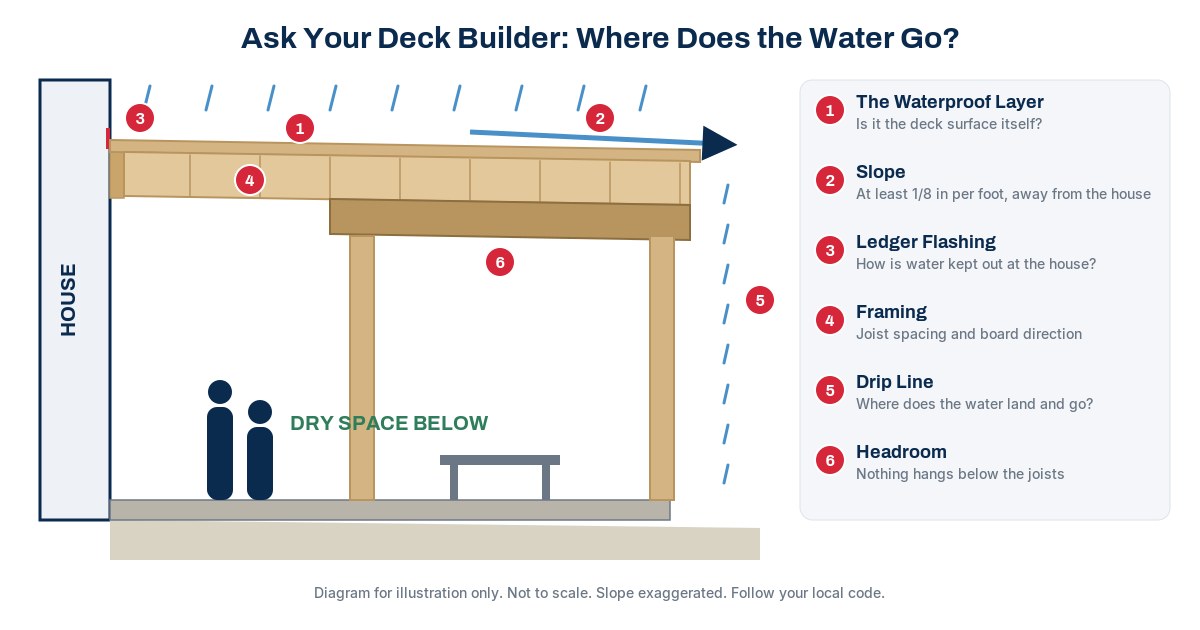
A regular deck has gaps between the boards, so rain falls straight through. Ask where the waterproof layer is: at the deck surface, in a layer under the boards, or below the joists. With AmeriDex, the boards and the Dexerdry seal are the waterproof layer, right at the surface. See how the system works.
How much slope will the framing have?
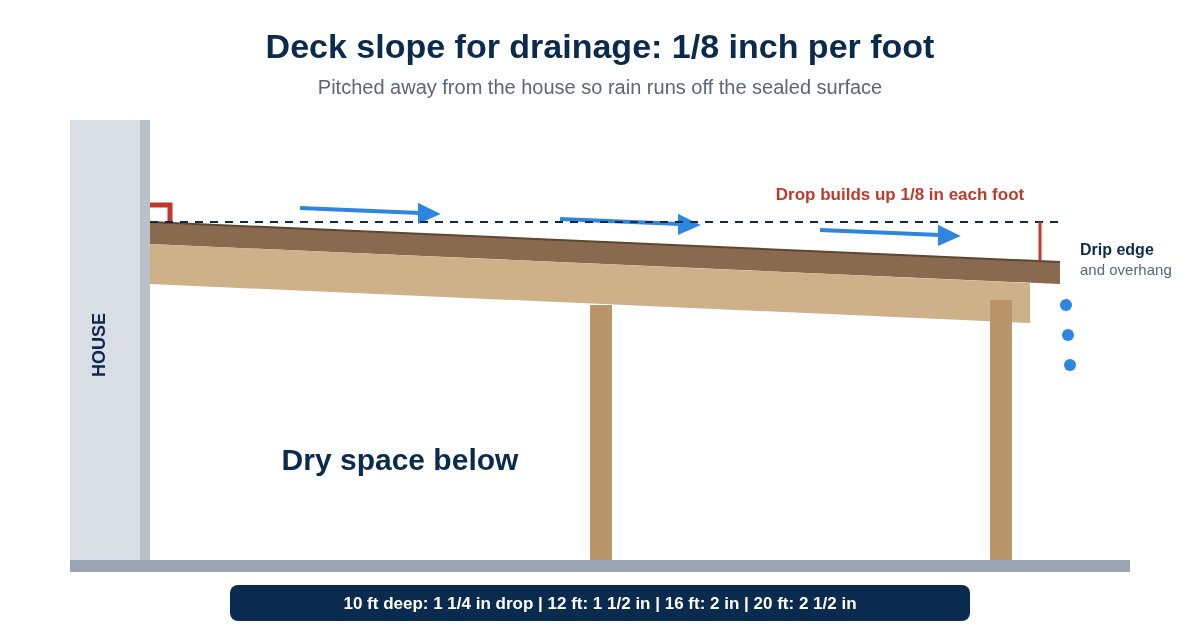
A deck that sheds water needs pitch built into the framing, at least 1/8 inch per foot away from the house. The slope is set before the boards go down, so ask now, not after. More in how much slope a deck needs.
Which way will the boards run?
Boards running parallel to the house, with the deck pitched away from it, is the ideal layout for AmeriDex. If the boards will run away from the house, ask how the builder will handle water at the house side.
How will the ledger be flashed?
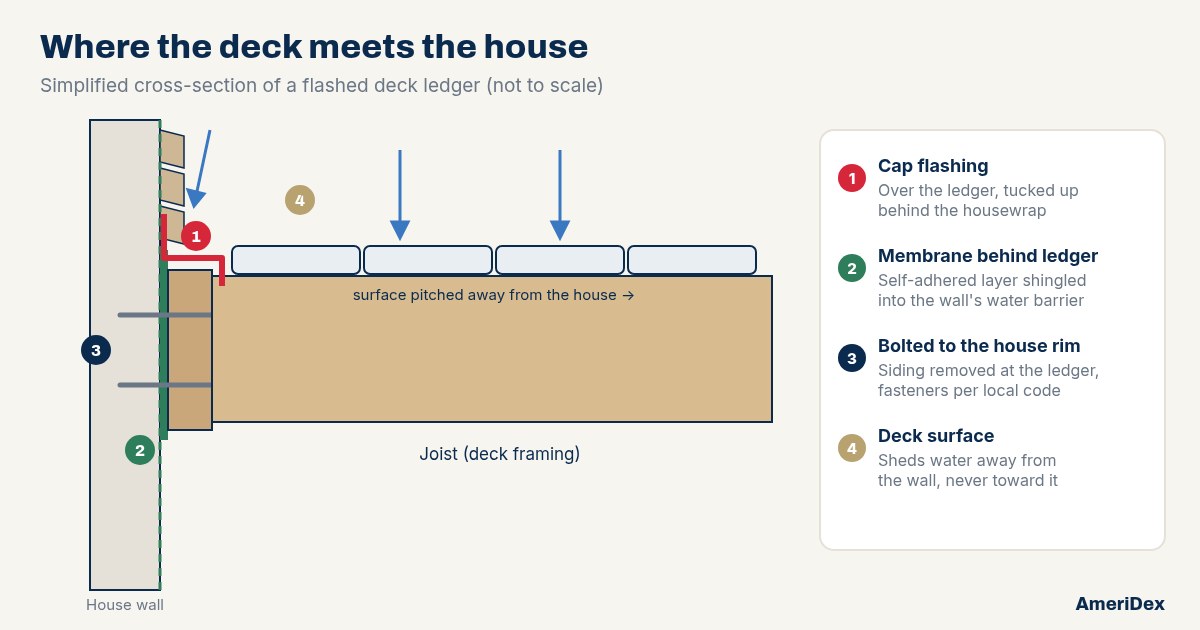
Where the deck meets the house is a common leak point. Ask what flashing goes at the ledger and how water is kept out of the wall and off the framing. See deck ledger flashing.
Where will the water land, and where does it go from there?
Water sheds off the drip edge at the outer edge. Ask where that drip line falls, whether gutters and downspouts are planned, and how the grade carries water away from the foundation. See does a waterproof deck need gutters.
What joist spacing will you use?
AmeriDex specifies 16 inches on-center joist spacing for residential decks. Confirm it on the framing plan.
How wide is the deck, and how will long runs be handled?
Ask how the layout handles a deck wider than one board length, so every seam is planned before framing. See building a deck wider than 20 feet.
Will anything hang below the joists?
Anything hung under the framing to catch water takes headroom and can hide the framing from view. With AmeriDex, nothing hangs below the joists, so the space below keeps its full clear height. See how high a deck should be.
Have you worked from the installation instructions?
Ask if the crew has read the current AmeriDex installation instructions and knows where to find install help. Correct installation and the specified edge details are essential. Builders can start at contractor resources and install help.
What warranty covers it, and how do I register?
Ask for the warranty in writing. AmeriDex boards and accessories carry a 25-year limited residential warranty and a 10-year limited commercial warranty under the AmeriDex Limited Warranty from A&M Building Products LLC. Homeowners can register the warranty after install.
AmeriDex goes in during new construction or a full re-deck on sound framing that already has the right pitch. It cannot be added to boards that stay installed, so the drainage plan has to be part of the build from the start.
Good Answers vs Red Flags
Good Answers
- The slope is on the framing plan, at least 1/8 inch per foot
- Ledger flashing is spelled out
- They can show where the drip line falls
- They follow the current installation instructions
- The warranty is in writing
Red Flags
- "Tight board gaps will keep it dry"
- "We can add drainage later"
- "The deck can be flat"
- No answer on where the water goes
- Guessing at code items
With AmeriDex, the deck boards lock onto the Dexerdry seal, the surface sheds rain off the drip edge, and the area below stays a dry space. Nothing hangs below the joists. Open sides can still get wind-driven rain. Read more about dry space decking.
Frequently Asked Questions
What should I ask a deck builder before building a deck with a dry space below?
Ask where the deck stops the water, how much slope the framing will have, how the ledger will be flashed, where the water will land, what joist spacing they will use, whether anything will hang below the joists, and what warranty covers the system.
How much slope does a deck need to shed water?
An AmeriDex deck slopes away from the house at least 1/8 inch per foot. The slope is built into the framing before the boards go down.
Can AmeriDex be added to my existing deck?
No. AmeriDex is for new decks and full re-decks on sound framing that already has the right pitch. It cannot be added to boards that stay installed.
Does AmeriDex hang anything below the joists?
No. The AmeriDex boards and the Dexerdry seal shed water at the deck surface, so nothing hangs below the joists and the space below keeps its clear height.
What warranty does AmeriDex carry?
AmeriDex boards and accessories carry a 25-year limited residential warranty and a 10-year limited commercial warranty under the AmeriDex Limited Warranty from A&M Building Products LLC.
Ready to Talk It Through?
Find a local dealer, start a free quote with your deck size and how you want to use the space below, or request free samples to see the boards and the seal up close. Always follow your local code.