
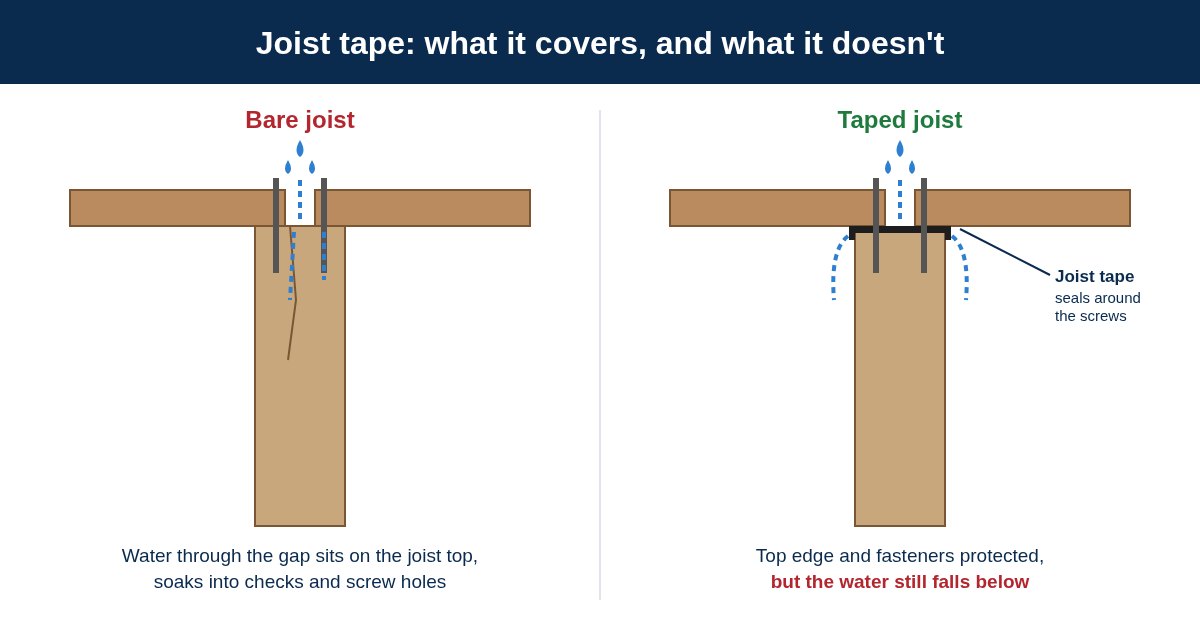

Joist tape is a self-adhered flashing tape, usually butyl or asphalt based, that goes on the top edge of joists, beams, and the ledger before the deck boards are installed. Builders and homeowners ask about it constantly, and the honest answer is that it is worth it on most decks, as long as you know exactly what it covers and what it leaves alone.
Why the top of the joist is the weak spot
On a conventional deck, rain runs through the gaps between boards and lands right on top of the framing. That top edge is also where the deck boards sit tight against the wood, so it stays damp longer than the open sides, and it is where every deck screw punches a fresh hole into the joist. Pressure-treated lumber also tends to develop cracks (called checks) on its surface as it dries, and those can lead water deeper into the wood. That slow, repeated soaking is the pattern we cover in why decks rot from the top down.
Joist tape protects the framing. It does nothing for whatever is under the deck.
Where joist tape earns its keep
Tops of joists
The main job. A strip on every joist covers the edge that catches water from the gaps and seals around the screws that go through it.
Beams, especially built-up ones
Doubled or tripled beams have seams on top where water can sit between the boards. Taping across the top covers those seams.
The ledger and rim joists
At the house, tape is often used as part of the ledger flashing details. Our guide to deck ledger flashing covers how those layers lap so water is led out, not behind.
Where board ends meet
Butt joints and breaker boards put two rows of screws and a seam right over the framing, so that spot gets extra water. Tape there is cheap insurance.
How to put it on so it actually helps
Do
- Apply it to clean, dry framing
- Pick a width that covers the top and laps a little down each side
- Press or roll it down firmly with no wrinkles or bubbles
- Lap pieces so upper layers shed over lower ones
- Follow the tape maker's temperature and surface instructions
Don't
- Tape over wet, soft, or decayed wood
- Leave loose edges or folds that can hold water
- Wrap framing in a way that traps water against the wood
- Count on tape to fix an existing rot problem
- Assume any tape is fine; use one made for deck framing
Taping over wood that is already wet or decayed can hold moisture in instead of keeping it out. If a screwdriver sinks into a joist, have a qualified deck builder look at it and replace the damaged framing before anything gets covered up.
What joist tape cannot do
This is where expectations go wrong. Joist tape keeps water from soaking into the top of the framing, but the water itself still goes exactly where it always went: through the board gaps and down to whatever is below. If you are hoping tape will stop the drips on your patio, it will not. It also does not protect the sides and bottoms of the framing from splash and humidity, and it does nothing about poor airflow under a low deck. Our post on water dripping through deck boards explains why decks drip and which options actually keep the area below dry.
So, is it worth it?
On a conventional gapped deck, usually yes. It costs little next to replacing framing, and the only easy time to install it is when the boards are off, during a new build or a full re-deck. If you are adding a below-joist drainage system under an existing deck, taping the framing while you have access is a common pairing, since the tray catches water but the joist tops still get wet. Our guide to retrofit drainage on an existing deck walks through that route.
With AmeriDex, you can skip most of the joist tape
Joist tape exists because rain gets to the tops of the joists. With an above-joist deck like AmeriDex, the boards and the Dexerdry seal shed rain off the top, so the water never reaches the framing in the first place. That takes away the main reason to tape every joist, beam, and board seam, and the space underneath becomes a dry space you can actually use.
The one place tape still has a job is at the house. The Dexerdry install help guidance is to use joist tape as a flashing overlap at the house on decks where the boards run perpendicular to the house. Always follow your local code and your builder's practice. You can see how the two approaches compare in above-joist vs below-joist deck drainage.
>.Joist tape is a smart, inexpensive way to protect the top of your framing on a gapped deck, put on dry wood with no wrinkles. Just do not mistake it for a way to keep the space under the deck dry. That takes a surface that stops the water. A sealed AmeriDex deck does that, and it does away with most of the tape too.
Building new or re-decking?
A new deck or a full re-deck is the moment to decide how you want to handle water on top of the framing and below it. Start a free quote and tell us about your project, request free samples to see the boards and the Dexerdry seal up close, or read how to keep the space under a deck dry for the full picture.