
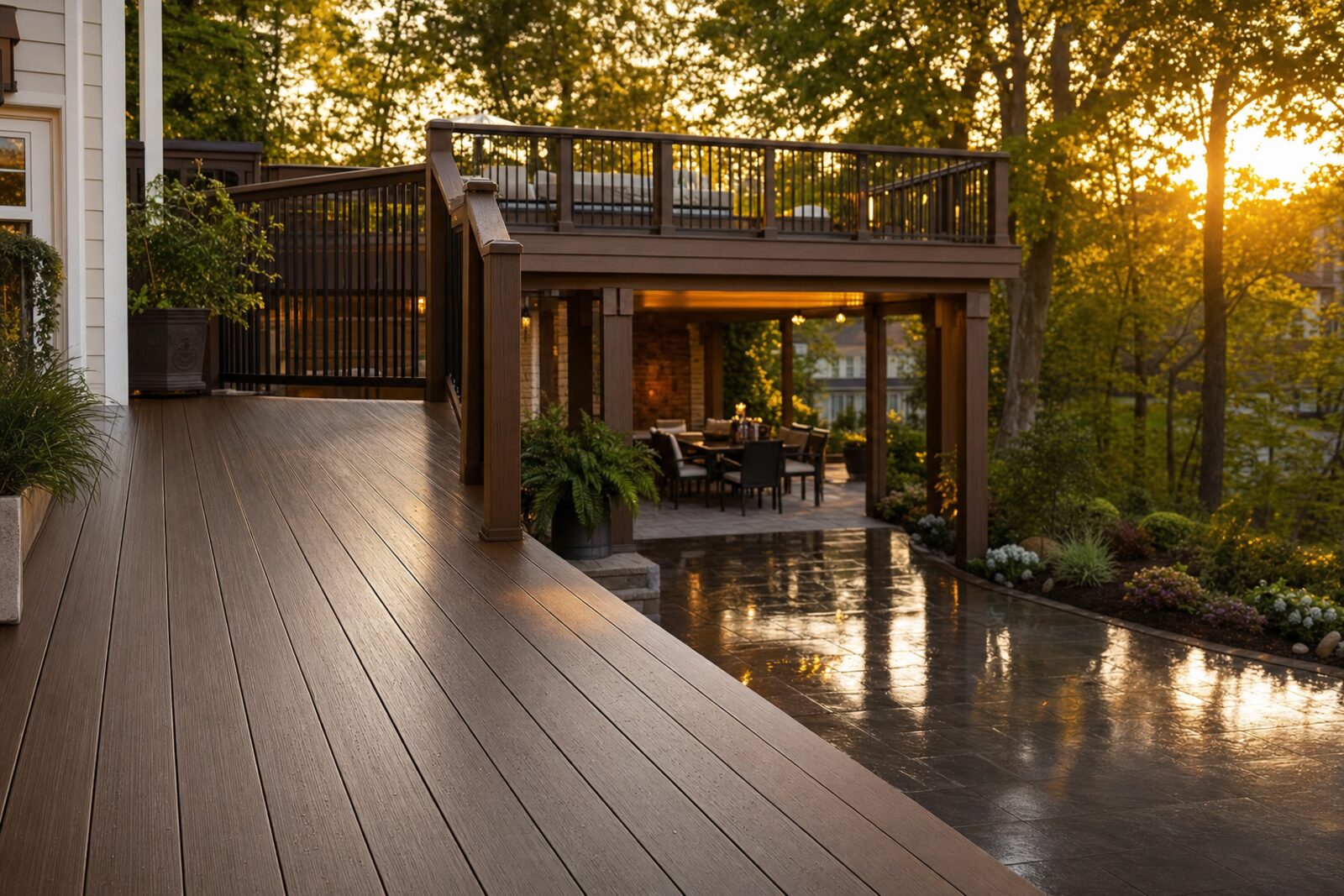
Every homeowner who wants to actually use the space beneath a raised deck eventually asks the same question: how do I keep it dry down there? Once you start shopping, you will find the market splits into two camps that sound similar but work in opposite ways. The label people search for is drainage, but what you are really choosing between is where the water gets stopped. That single decision shapes how long your deck lasts, not just how dry your patio stays.
The two approaches, in plain terms
A below-joist system is a tray, panel, or membrane hung underneath the framing. Water falls through the gaps between the deck boards, lands on the tops of the joists, then drips down onto the tray and drains away to the side. It is the approach most often sold as a retrofit because it can be added under a deck that already exists. An above-joist system works higher up: a seal sits in the gap between each board so water never gets through in the first place. It runs across the surface and sheds off the edge, and the framing below stays dry.
The real question is not how you drain the water. It is whether your framing ever gets wet at all.
Why the location of the seal matters so much
Most deck deterioration does not come from a single flood. It comes from the wet-dry cycle. Water lands on the framing, that shaded wood dries slowly, and the next storm wets it again before it has finished drying. Run that cycle through a few hundred storms and you get soft joists, corroding fasteners, and a ledger board holding water right where the deck attaches to the house. A below-joist tray does nothing to break that cycle, because by the time the tray catches the water, it has already passed over and through the framing. An above-joist seal stops the water before it ever touches the wood, so the cycle never starts. We walk through the full mechanics in the above-joist deck drainage guide.
Side by side
Both approaches can give you a dry patio underneath. The difference is what happens to the deck structure itself over the years you own it.
Below-joist tray
- Catches water after it falls through the gaps
- Framing still gets wet on every storm
- Wet-dry cycle keeps running
- Often retrofitted under an existing deck
- Protects the space, not the deck
Above-joist seal
- Stops water at the deck surface
- Joists, beams, and ledger stay dry
- The rot cycle never starts
- Built in as part of a new deck
- Protects the deck and the space below
Where AmeriDex fits
AmeriDex is an above-joist system. The deck surface is built from cellular PVC deck boards with a proprietary ASA cap, and every board locks onto a Dexerdry seal, an automotive-grade TPE component, as the deck goes together. That seal closes the gap between boards so rain sheds off the surface instead of falling through onto the framing. The complete AmeriDex Dryspace System is the cellular PVC deck boards plus the Dexerdry component working together, which is what lets the space below stay dry while the structure itself stays protected.
A below-joist tray manages water after the damage window has already opened. An above-joist seal closes that window entirely, which is why it protects the deck itself and not only the room beneath it.
How to decide before you build
The choice usually comes down to timing. If you already have a deck and simply want to keep the patio underneath usable, a below-joist tray is the retrofit option. If you are building new, that is the moment to design the water out of the structure from the start, and an above-joist seal is the only one of the two that does that. A few questions worth answering before you sign anything:
- Am I building new or working with an existing deck? An above-joist seal is installed between the boards during the build, so it is a new-construction system.
- Do I want to protect the space, the structure, or both? Below-joist protects the space. Above-joist protects both.
- What does the warranty actually cover? Look for coverage on the deck board and the seal together, not just the surface. The AmeriDex Dryspace System carries a 25-year residential and 10-year commercial warranty on the deck board and seal.
If you want the two approaches laid out point by point, the above-joist vs below-joist comparison goes deeper, and how the system works shows the boards and seal in detail.
Planning a new build is the right time to make this call. Request free samples to see and feel the boards and seal, and start a free quote to size the system for your project.